- Corporate learning
- Reading Time: 5 Min

In today's business landscape, training and development has evolved from an operational expense to a critical strategic investment. However, the big question that continues to resonate with boards of directors is always the same: How does this investment translate into impact for the company?
If you are in charge of Human Resources, Training or Organizational Development in a company with a vision, you know that the real challenge is not only to train, but to demonstrate that this investment has a tangible impact in the profitability of the business.
Today, we will guide you through a simple and actionable methodology designed to close the gap between training activity and key business indicators (KPIs), allowing you, at last, measuring and showing the real impact of your training investment.
From the observable to the measurable
To understand how to measure impact, first we must go beyond the simple “satisfaction/reaction” of the course.. The most recognized model for this is the Kirkpatrick. It is not just a list of levels; it is a series of consecutive and progressive steps that take you from the initial employee experience to the final business outcome.
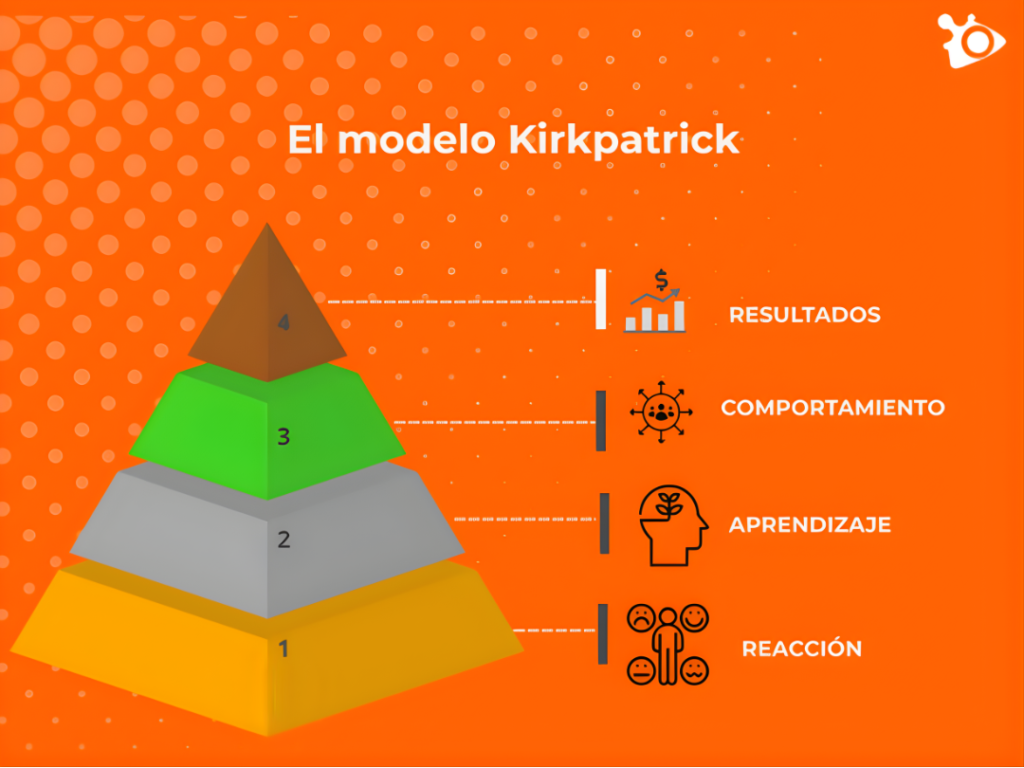
The most common mistake is to stop at the Level 1. To convert your trainings into justifiable models of your ROI (return on investment), you must move up to level 3 where your training begins to be visible in the operation and, crucially, connect it to level 4 which will be tangible in the measurement of the KPIs.
- Level 1 - Reaction: Did you like it? Measures satisfaction and perception of the course.
- Level 2 - Learning: Did they learn? Measures the acquisition of knowledge, skills or attitudes.
- Level 3 - Behavior: Do you apply it? Measures whether the employee is using what he/she has learned in his/her daily work.
- Level 4 - Results: Business improved? Measures the final impact on the KPIs of the company (e.g. sales, quality, efficiency).
STEP 1: Diagnosis
Objective: Establish the baseline and the KPI before any intervention.
Before a single employee starts the course, apply a diagnostic evaluation (pre-test).
Focus on the KPI: This test should be brief (3-5 questions) and be directly related to the skill you are going to teach and the KPI you are looking to improve (e.g. reduce the incidence of operational errors, improve average response time, etc.).
Brandon Hall Group studies indicate that companies that link training directly to business objectives have, on average, a 4.5 times higher ROI on their investments.
STEP 2: Measuring change
TargetConfirm that the training changed the way the employee does his or her job.
To connect training with the results your company expects, you need to measure level 3: Behavior. A successful course is one that generates a new productive habit..
How to introduce this step in your company?
- Follow-up surveys to leadersSend a short survey to the employee's direct leader 30 days after the training. Include questions such as “Have you noticed a change in the collaborator's skill X after the course?”, to rate each item from 1 to 5 (scale of 1 to 5). Likert).
- Validation by observation (Coaching): Ask leaders to rate 5 critical post-course employee interactions or tasks using a simple rubric. If the rating goes up, your training is working at the performance level!
Tools that allow you to design gamified and 3D simulation-based learning experiences are of great help, as they facilitate this transition by allowing critical behavior to be practiced in a safe environment before being taken to the real playing field.
STEP 3: Evidence of impact
TargetCredibly attribute the behavior change to the training (level 4).
The immediate effect of training often wears off. The actual results in the KPIs of each company are seen over time, so you need a maturation period.
Actions to be taken:
- Selection and monitoring: Select the KPI of the one you initially chose and monitor its performance for 90 days after the trained group has completed it.
- The winning graphic: Create a simple graph with only two points to present to management: KPI performance before training (your baseline) VS KPI performance before training (your baseline) VS KPI performance before training (your baseline) VS KPI performance before training (your baseline). KPI 90 days after training (your strategic outcome).
Impact is the movementIf the KPI moved in the desired direction (e.g., error rate dropped from 15% to 5% or response time decreased), you can credibly argue that training was a key contributing factor. You just calculated your ROI!
Transform yourself into a strategic partner
Training is not a task, it is a your opportunity to lead change. Measuring the impact of training is no longer an administrative task; it is an administrative task. your strategic manifesto.
In the dynamic business landscape, your ability to transform a training and development budget into tangible metrics of efficiency, productivity and profitability is what will define your leadership. You are one step away from being a cost center to a cost center. become an engine of growth.
Would you like to know how O-Lab AI can help you create measurable trainings that help you justify the impact of the training? Schedule a personalized consulting session and let's take your training strategy to the next level.