- Corporate learning
- Reading Time: 4 Min

Have you ever felt that your employees are disconnected during training sessions?It's not lack of interest, it's digital fatigue.
In a corporate environment where notifications and messages never stop, attention has become the scarcest resource in any organization. For Human Resources and Learning & Development leaders, the challenge is no longer just what to teach, but how to do it without overwhelming their teams’ cognitive capacity. This is where microlearning microlearning becomes the ultimate precision tool.
Learning psychology: the power of “knowing how”
For a learning bite to be effective, it must be designed with a surgical focus on performance. The most common mistake is falling into“knowledge for knowledge’s sake" (accumulated theory) instead of “knowing how to do” (executable competence).
What criteria ensure real “knowing how”?
The 30-minute rule: If the employee does not have a clear opportunity to apply what they learned within the next 30 minutes of their workday, the content is too theoretical.
MVP utility filter (Minimum Viable Product): Each learning capsule should answer a single question: “How do I solve X problem right now?”If you need historical background, it's not microlearning.
Measure output, not input: Stop measuring how many people “watched” the video. Measure whether the error rate in the process decreased after the capsule.
The art of spacing: how to beat forgetting?
The human brain forgets up to 80% of what it learns within a week if there is no reinforcement. Effective microlearning leverages the Spacing effect, which distributes cognitive load across intentional intervals to move information from short-term to long-term memory.
The ideal spacing sequence:
Moment 0 (Acquisition): The learning capsule (RAP).
Moment +24 hours (Retrieval): A quick challenge, gamified activity, simulation, or quiz that forces the brain to retrieve the information.
Moment +7 days (Reinforcement): A simulation or practical case where the learner applies the knowledge in a safe environment.
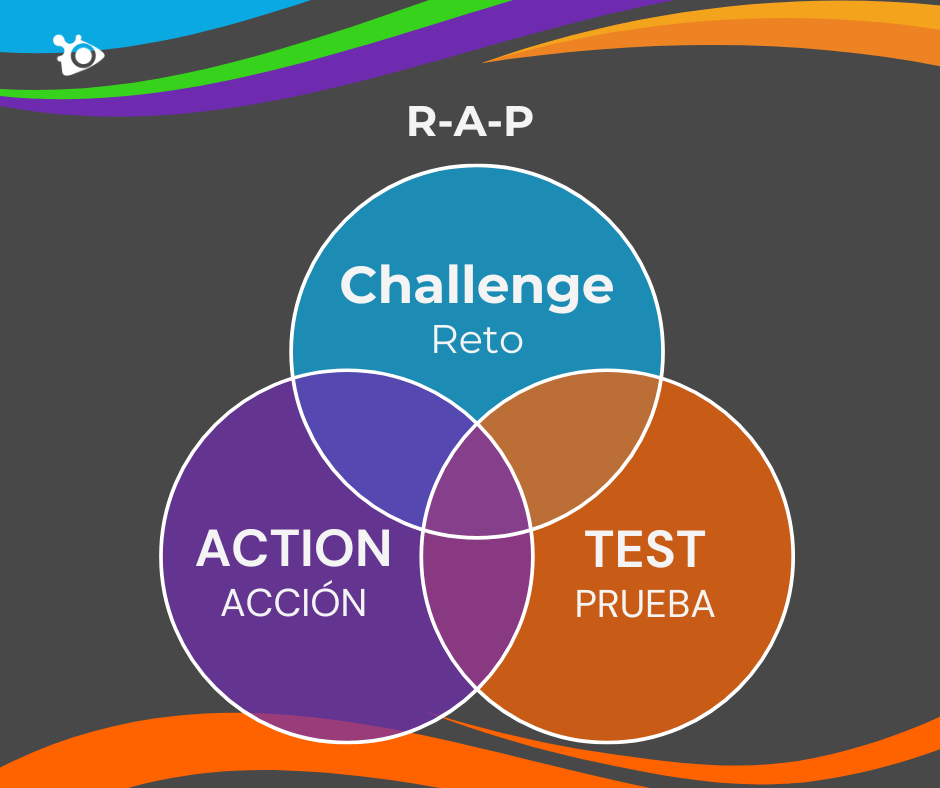
The RAP formula for successful microlearning
If your capsule doesn’t include these three elements, it’s likely to get lost in the noise:
R - Challenge | 30 - 45 sec: The hook. Present a real problem or critical question the employee faces in their role.
A - Action 2 - 3 min: The solution. The exact step-by-step process, tool, or key concept to solve the challenge. No filler.
P - Test | 1 min: Validation. An interaction, critical decision or 3D simulation that proves the employee can execute what they just learned.
Fighting fatigue with interactivity
The antidote to distraction is active participation. Game mechanics (gamification) don’t just make learning more engaging, they trigger dopamine, the neurotransmitter responsible for focus and motivation.
When microlearning is combined with game elements and simulations, we move from passive learning (watching and listening) to active learning (doing and deciding). The result: less overload, more real competence.
Conclusion: from quantity to relevance
In 2026, the success of a training department will not be measured by how many course hours were completed, but by how quickly employees can apply what they learned to solve real business problems.
Reducing cognitive overload doesn’t mean “teaching less.” It means teaching better,respecting people’s time and mental capacity.
Would you like to see how O-Lab can help you design training programs that truly apply effective microlearning? Schedule a personalized consulting session and let's take your training strategy to the next level. 🚀